

8,485 Harrow residents claimed out-of-work benefits in October, 4.9% of 16 to 64s. Claims by 16 to 24 year olds are the highest since September 2021.
8,485 people in Harrow were claiming benefits mainly because they were out of work in October 2026. That is the highest figure since July 2025.
The Office for National Statistics published the figures on Tuesday 17 November. The count is 4.9 per cent of residents aged 16 to 64 (ONS claimant count via nomis).
It rose by 125 from September, when the revised figure was 8,360. It is 210 higher than in October 2025, when it stood at 8,275.
Young claimants at their highest since 2021
The sharpest change is among the youngest claimants. 1,125 people aged 16 to 24 were claiming in October. That is the most since September 2021, when the count was 1,200 and still falling from its pandemic peak (ONS via nomis, by age).
The under-25 figure has risen every month since June, when it was 1,060.
| Age band | October 2025 | October 2026 | Change |
|---|---|---|---|
| 16 to 24 | 1,065 | 1,125 | up 60 |
| 25 to 49 | 5,190 | 5,200 | up 10 |
| 50 and over | 2,020 | 2,160 | up 140 |
| All ages | 8,275 | 8,485 | up 210 |
The ONS publishes the 16 to 24 and 50 and over bands directly. The 25 to 49 figure is the total minus those two.
Two other details stand out in the split by sex:
- The whole of the year’s rise is among men. Male claimants went from 4,450 to 4,710, while female claimants fell from 3,825 to 3,775.
- The rise among under-25s is all young women. Women aged 16 to 24 went from 380 to 440. Young men stayed at 685.
The over-50s count of 2,160 matches July 2025. Before that, it was last higher in June 2025, at 2,260.
Which parts of Harrow have the most claimants
The ONS also publishes the count for each of Harrow’s 22 wards. The rate runs from 2.9 per cent in Pinner South to 7.2 per cent in Wealdstone North (ONS via nomis, Harrow wards).
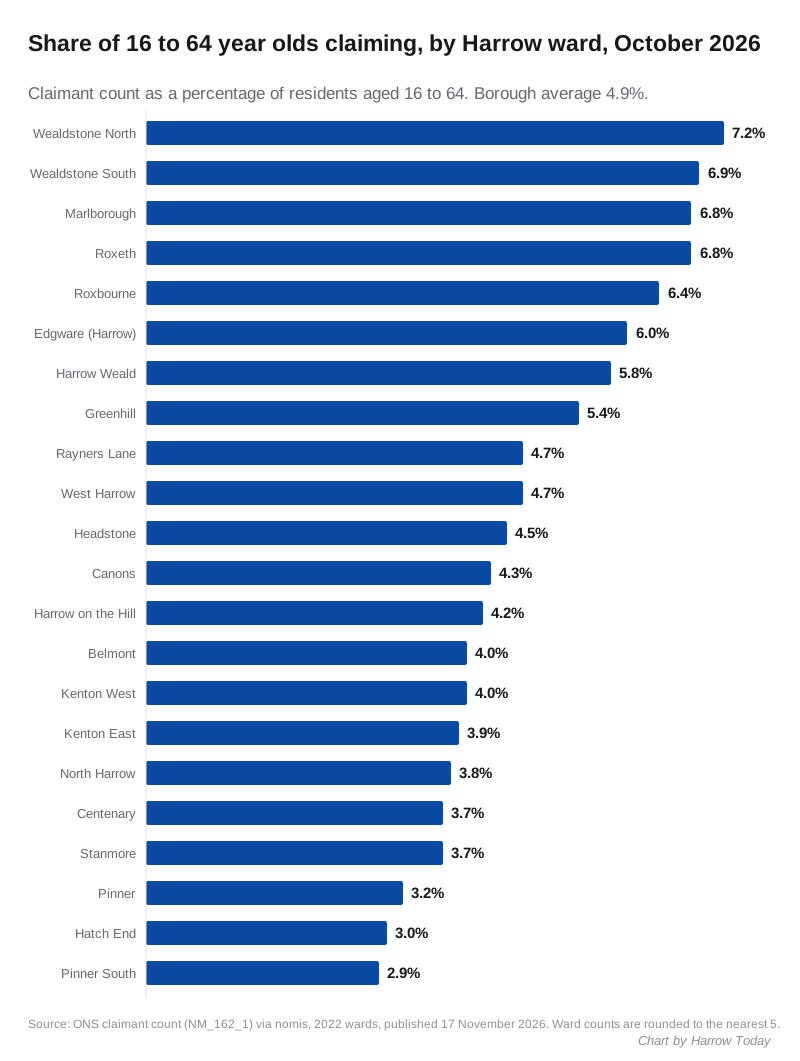
The five wards with the highest rates:
| Ward | Claimants | Rate |
|---|---|---|
| Wealdstone North | 515 | 7.2% |
| Wealdstone South | 400 | 6.9% |
| Marlborough | 615 | 6.8% |
| Roxeth | 765 | 6.8% |
| Roxbourne | 430 | 6.4% |
Roxeth, which covers much of South Harrow, has the largest number of claimants of any ward, at 765.
The lowest rates are in the north-west of the borough: Pinner South at 2.9 per cent, Hatch End at 3.0 per cent and Pinner at 3.2 per cent. Stanmore and Centenary are both at 3.7 per cent.
Ward counts are rounded to the nearest five, so the 22 wards add up to 8,490 rather than the borough’s 8,485.
Harrow and its neighbours
Every borough and district bordering Harrow saw its count rise in October. London as a whole rose by 7,465.
| Area | September 2026 | October 2026 | Rate |
|---|---|---|---|
| Brent | 17,210 | 17,460 | 7.2% |
| Ealing | 16,905 | 17,175 | 6.5% |
| London | 343,555 | 351,020 | 5.6% |
| Barnet | 12,970 | 13,365 | 5.1% |
| Hillingdon | 10,690 | 10,900 | 5.0% |
| Harrow | 8,360 | 8,485 | 4.9% |
| United Kingdom | 1,672,900 | 1,707,320 | 3.9% |
| Hertsmere | 2,415 | 2,475 | 3.6% |
| Three Rivers | 1,595 | 1,655 | 2.8% |
Harrow’s rate is still the lowest of its four London neighbours. Across all 33 London local authorities, 13 have a lower rate and 19 have a higher one (ONS via nomis, London boroughs). The City of London is lowest at 1.2 per cent. Barking and Dagenham and Newham are highest, both at 7.5 per cent.
What this number is, and what it is not
The claimant count is not an unemployment rate. The ONS says it “does not attempt to measure unemployment” (ONS quality and methodology information).
It counts people claiming Jobseeker’s Allowance, plus Universal Credit claimants who are required to look for work. Some of those already have a job but earn little enough to stay in the group.
The latest month can be revised once. August’s figure was first published as 8,375 and now stands at 8,245, so October’s 8,485 may also move when the November figures come out.
What it means for you
If you are looking for work, the council runs Work Harrow, which it describes as “a free training and employment service for unemployed people in Harrow”. It lists vacancies and takes registrations for support.
For 16 to 24 year olds, the rise matters most. Learn Harrow has City Hall funding for free vocational courses in care, business admin and classroom support, and we set out how to book an assessment for the £1.4m course fund.
Sources
- ONS claimant count, dataset NM_162_1 via nomis, updated 17 November 2026, for every figure in this article
- ONS, Claimant Count quality and methodology information, for what the count measures and the revisions rule
- Harrow Council, Work Harrow
Have your say