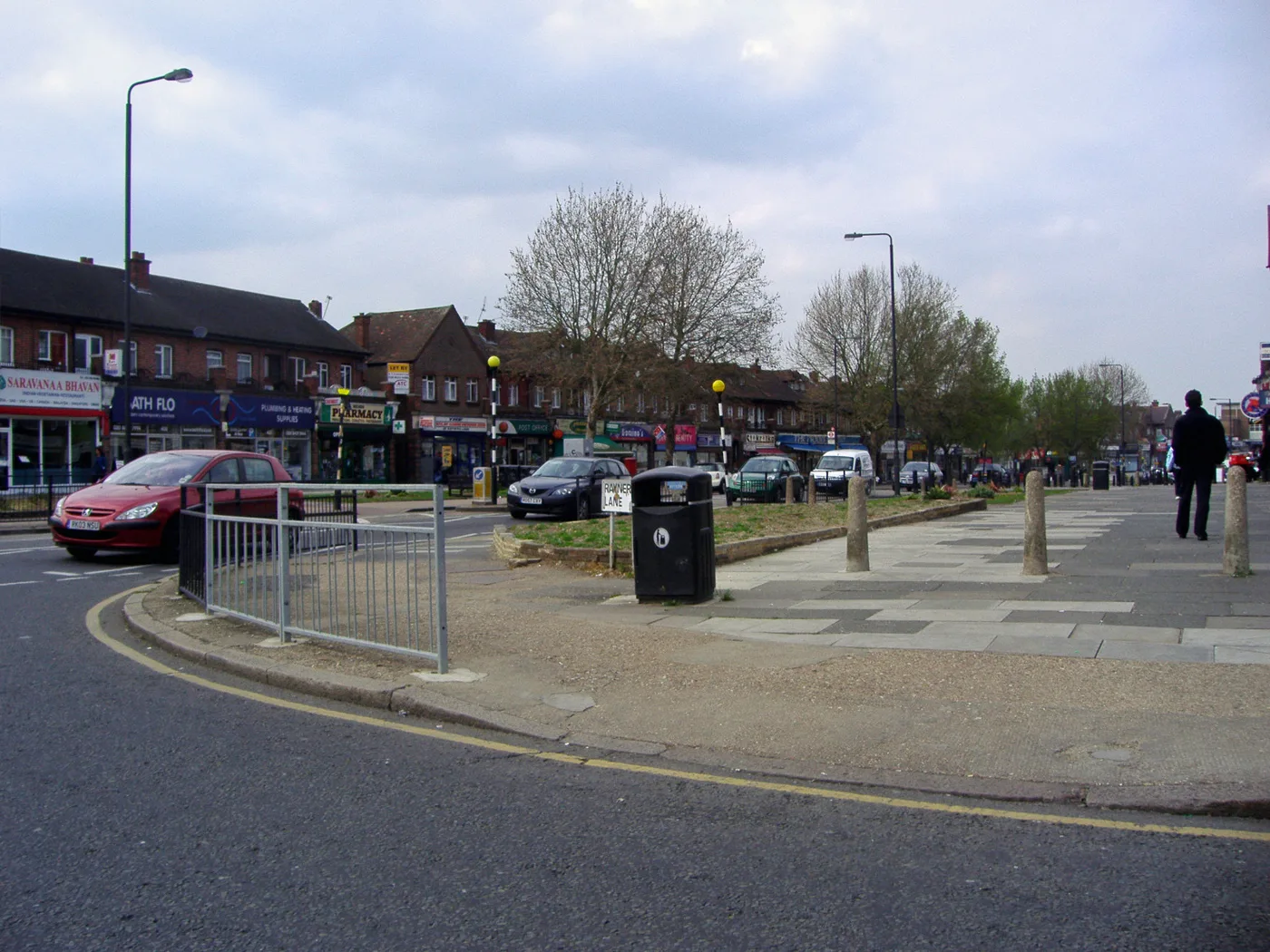

Cabinet votes on 24 September on keeping the Rayners Lane red route. Double parking fell from 668 to 115 on a Friday, and a taxi bay returns at the station.
Double parking in Rayners Lane town centre has fallen by more than 80% since the red route went in, and Harrow Council’s Cabinet is asked on Thursday 24 September to make the scheme permanent.
The evidence is in the report going to that meeting, which sets out what parking surveyors counted before and during the six-month trial (Outcome of the Six Month Experimental Traffic Order Trial). The red route covers parts of Rayners Lane, Alexandra Avenue and Village Way East. It started on 24 November 2025 as an experimental traffic order and the trial ended on 20 May 2026.
What the counts show
Surveyors watched the three roads from 7am to 10pm on a Friday, a Saturday and a Sunday, three times: a baseline in May and June 2025, then again in December 2025 and April 2026. These are our totals from the council’s road-by-road figures, published as Appendix A to the report.
The council’s own summary of the same data is a reduction of roughly 80 to 85% on Fridays and Sundays, and over 50% on Saturdays. Rayners Lane itself, where the problem was worst, carried the biggest fall: 690 instances on the baseline Sunday against 92 in April.
Officers say the improvement arrived immediately and held throughout the trial.
What the emergency services and the bus operator said
The council asked the people who have to drive through it. Their answers are not unanimous.
- The Station Commander at Harrow Fire Station in Pinner: “Whilst I do not have data to specifically support the implementation of the red route, crews have noticed reduced traffic obstructions when attending the area. This in itself demonstrates a positive impact on response to incidents locally.”
- The Northolt Station Commander had a different experience: “After speaking with the watches, it seems there was little difference due to cars ignoring the red route and continuing to double park. I think it’s got to be some improvement and if made permanent with enforcement cameras it would make a noticeable difference.”
- The Metropolitan Police Service told the council it “would not oppose the scheme being made permanent”.
- First Bus, which runs the 398, H9, H10 and H12 through the town centre, said: “In summary, the trial was successful and demonstrated improved bus journey times for these routes.”
- The London Ambulance Service said: “The team here had no negatives to say about this trial. It is hard to measure the impact, but no news is good news from our position.”
What people objected to
Eighty-seven people responded during the trial. Twenty of them formally objected.
Almost none of the objections were to the idea of a red route. They were about how it works in practice, and the same complaints recur:
- not enough drop-off and pick-up space, especially at Rayners Lane Underground station
- less parking available, and harder to reach
- the effect on local businesses
- operating hours that run well beyond the peak
- enforcement of very short stops
Officers reject the central ask. Allowing brief stopping “would undermine its core purpose”, they write, because the scheme only works if the no-stopping rule is consistent and therefore enforceable.
The four changes coming with it
The Traffic and Road Safety Advisory Panel considered all of this on 21 July and voted to recommend that Cabinet make the order permanent, with modifications. Those are:
- Loading bay hours cut back to a daytime window. The six loading bays, four on Rayners Lane outside Nos. 331, 354, 404 and 415, and two on Alexandra Avenue outside Nos. 429 and 467, currently run 24 hours a day, seven days a week. Monitoring found peak loading is a daytime activity and the evening use is mostly short-stay parking and drop-offs. The officer report floats 7am to 6.30pm; the panel minute records members suggesting 1pm to 6.30pm. The exact hours are still to be settled.
- Motorcycle bays stay as they are, on 24-hour operation. There is one on Rayners Lane outside No. 363 and three on Alexandra Avenue outside Nos. 436, 443 and 454, and the surveys found no mismatch between the hours and the demand.
- A taxi bay comes back outside Rayners Lane station. Two were taken out during the trial because they were barely used. After talks with Transport for London, officers propose reinstating one.
- Better pick-up and drop-off on the side streets, “where feasible”, with signage pointing to it.
Blue Badge holders may stop on the red route to pick up or set down, and so may licensed taxis. The council intends to enforce with CCTV as well as civil enforcement officer patrols.
Where there is still space to park
The same survey work measured parking stress, which is how full the kerb is. On Alexandra Avenue it is regularly at or above 80% from about half past three or half past four in the afternoon until 9pm. On Rayners Lane it runs at or above 80% from about half past two until half past nine, often close to full.
Imperial Drive is the exception. Officers describe it as underused, with only short and isolated busy spells, and say drivers could be encouraged onto it to take pressure off the worst streets. It is within walking distance of the shops.
What it means for you
If you drive in Rayners Lane town centre, the practical position is unchanged and about to become permanent. You cannot stop on the red route at all, not even for a moment, unless you hold a Blue Badge or are driving a licensed taxi dropping off or collecting. Enforcement is by camera as well as by patrol.
If you load or unload for a business, the bays you use are about to stop being 24-hour. The new hours have not been set, so watch for the signs changing.
If you are collecting someone from the station, one taxi bay is due back on Alexandra Avenue, and the council says it will look at drop-off space on the nearby streets.
If you are parking to shop, the kerb is fullest from mid-afternoon to mid-evening on both main roads, and Imperial Drive has space when they do not.
Two ward councillors have asked for more. Councillor Thaya Idaikkadar reported traders opposing the extension of parking control hours from 6.30pm to 8.30pm and the introduction of Sunday charging, and asked for a meeting with local businesses before anything is finalised. He also said the outcome of the ongoing Rayners Lane car park negotiations should be settled first. Councillor Krishna Suresh, who welcomed the scheme, asked for the controlled parking zone hours on the High Streets to come back from 8.30pm to 6.30pm.
Cabinet meets at 6.30pm on Thursday 24 September. The decision is subject to call-in, so it is not final on the night. We track live closures and travel on our Harrow roadworks and travel page, and the borough’s parking rules and tariffs are set out in parking in Harrow.
Update, 27 September 2026: Cabinet approved the recommendation on 24 September. The red route is to be made permanent, with the revised loading bay hours, the 24-hour motorcycle bays kept, the taxi bay reinstated outside Rayners Lane station and better pick-up and drop-off space on nearby streets where feasible. The decision is subject to call-in until 2 October (Cabinet decision).
Sources
- Outcome of the Six Month Experimental Traffic Order Trial: Better Access to Parking and Loading with Reduced Congestion in Rayners Lane Town Centre, report to the Traffic and Road Safety Advisory Panel, 21 July 2026, and to Cabinet, 24 September 2026.
- Appendix A: Parking Activity Monitoring, Double Parking, the road-by-road survey counts behind the chart.
- Minutes of the Traffic and Road Safety Advisory Panel, 21 July 2026, for the recommendation to Cabinet and the ward councillors’ comments.
- Harrow Council Cabinet, 24 September 2026, the full agenda.
Have your say